To enrich the research atmosphere of the school and broaden the research horizons of faculty and students, on November 3, the School of Automotive and Traffic Engineering specially invited Dr. Zhang Shicheng, Chairman and specially appointed expert of the Chinese Association of German Mechanical and Electrical Engineers and former head of the Daimler R&D Center in Germany, to deliver an academic report titled "Principles of Physical AI Resistance Sensing in Vehicle Longitudinal Dynamics." More than 100 faculty and student representatives of the automotive discipline attended the report, which was chaired by Jiang Haobin, Executive Director of the automotive discipline.
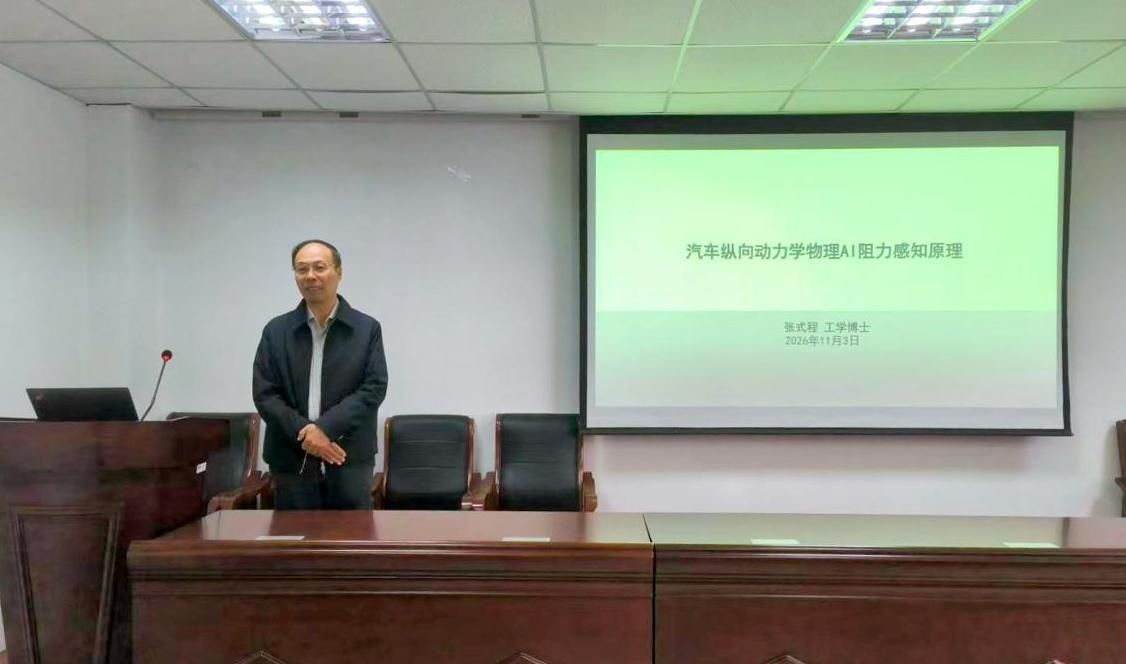
Dr. Zhang Shicheng delivering the academic report
In his report, Zhang first briefly introduced the organizational structure of the Association, its membership size, and its main activities in domestic and international academic exchange and talent services. Focusing on the technical concept of physical AI, he compared the traditional SAE road coasting test specification with the classical calculation methods in the Bosch engineering manual, and analyzed the features and limitations of existing methods for testing aerodynamic and road resistance. Based on vehicle longitudinal dynamics, the report established a set of differential equations of vehicle motion using Newton's second law. By solving the nonlinear differential equations analytically, the rolling resistance coefficient, aerodynamic drag coefficient, and real-time ambient wind speed can be calculated online using only the vehicle's measurable speed and acceleration signals, enabling real-time sensing of aerodynamic and road resistance. Simulation cases were used to verify the effectiveness of the method.
At the level of practical application, Zhang expanded the diverse application scenarios of physical AI. In the automotive field, it can support intelligent connected cloud-based fault diagnosis, accurate prediction of the driving range of new energy vehicles, and intelligent cabin environment parameters and driving safety warnings. The dynamic analytical approach can also be extended to explore the technical feasibility of aerodynamic drag measurement and real-time monitoring of power output status in high-speed maglev trains and aircraft, demonstrating the potential of physical AI across equipment domains and offering prospects for the engineering promotion and cross-industry integration of dynamic physical AI technology.
Zhang Shicheng holds a PhD in Engineering. In 1977, he was admitted to Harbin Institute of Technology to study welding, where he successively obtained his bachelor's, master's, and doctoral degrees. In 1988, he went to Technische Universität Braunschweig in Germany for postdoctoral research. From 1989 to 2024, he served as a senior engineer, senior expert, and project leader at the Daimler Group R&D Center in Germany. He has published more than 50 academic papers, obtained a number of patents arising from his work, and received multiple group awards. He is currently Chairman of the Chinese Association of German Mechanical and Electrical Engineers, Vice Chairman of the Global Automotive Elite Organization, a visiting professor at Harbin Institute of Technology, a visiting researcher at the Haixi Institute of the Chinese Academy of Sciences, and a specially appointed expert of the China Overseas Chinese Federation. He previously served as a director of the Welding Technology Committee of the German Automotive Technology Association (FAT), a convener of the Welding Technology Committee of the Society of Automotive Engineers (SAE) in the United States, and a member of the Economic and Scientific Committee of the Expert Advisory Committee of the Overseas Chinese Affairs Office of the State Council. His research interests include vehicle dynamics, structural lightweighting, physical AI, and digital twin technology.


