To enrich the research atmosphere of the school and broaden the research horizons of faculty and students, on November 3, the School of Automotive and Traffic Engineering specially invited Li Yuanzhe, an expert of the Chinese Association of German Mechanical and Electrical Engineers and Senior Researcher at the Institute of Automotive Engineering of Technische Universität Berlin, to deliver an academic report titled "Applications of Large Language Models in Pedestrian–Automated Vehicle Interaction." More than 100 faculty and student representatives of the automotive discipline attended the report, which was chaired by Jiang Haobin, Executive Director of the automotive discipline.
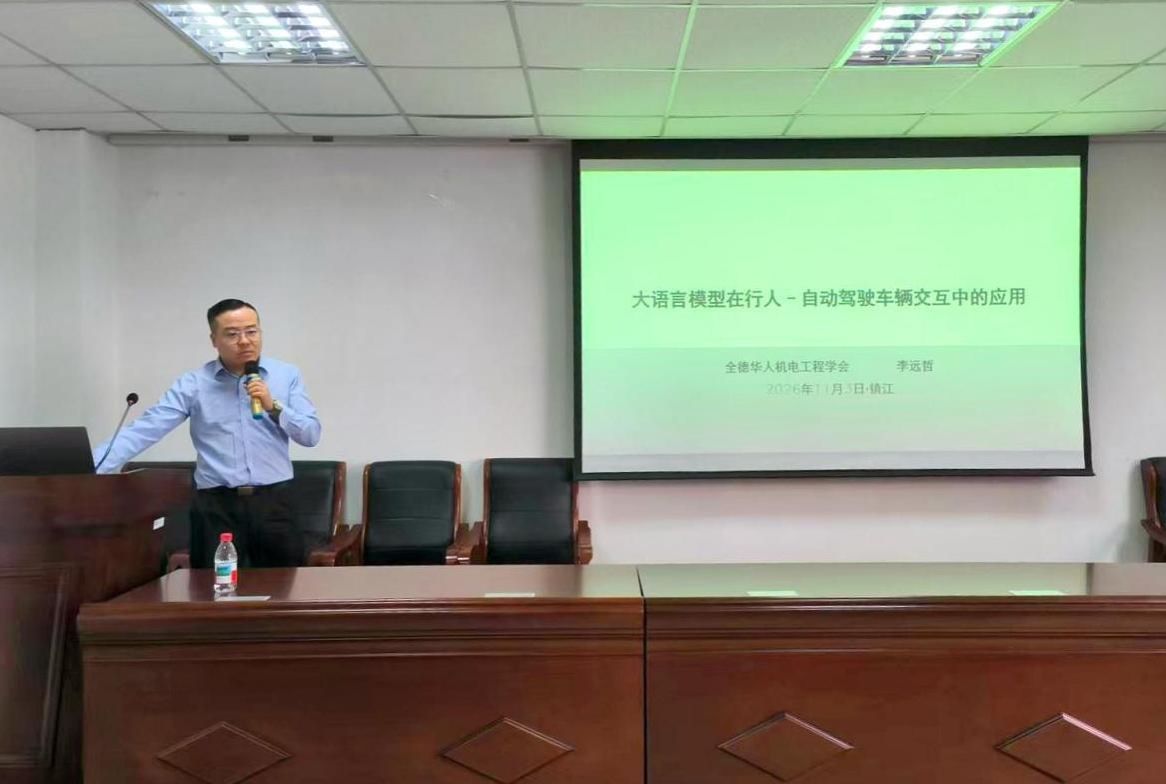
Dr. Li Yuanzhe delivering the academic report
In his report, Li introduced the basic situation of Technische Universität Berlin and its Institute of Automotive Engineering. Drawing on European and American traffic accident statistics, he illustrated the practical significance of pedestrian intention prediction in vehicle–pedestrian interaction for the active safety of autonomous driving, noting that pedestrian behavior is inherently uncertain and that accurately predicting crossing intentions is a key prerequisite for risk warning, safety decision-making, and active control. He systematically reviewed the technological evolution in this field, analyzing the implementation logic and inherent shortcomings of three traditional technical routes: static single-modality, dynamic temporal single-modality, and multimodal fusion. He focused on four mainstream technical approaches that apply large language models and vision-language models (LLM/VLM) to pedestrian intention prediction, explaining the technical mechanisms of each approach and relevant representative research results.
The report further elaborated on a pedestrian intention prediction method based on semantic distillation with vision-language models, analyzed the technical advantages and practical challenges of applying large models to vehicle–pedestrian interaction perception, and examined the directions of technological iteration and engineering deployment in this field, providing important references for research on vehicle–pedestrian interaction perception in autonomous driving.
Li Yuanzhe is a researcher and master's supervisor at the Institute of Automotive Engineering of Technische Universität Berlin and a member of the Chinese Association of German Mechanical and Electrical Engineers. He completed his undergraduate, master's, and doctoral studies at Harbin Institute of Technology, Beijing Institute of Technology, and Technische Universität Berlin respectively. His main research interests include artificial intelligence, human–vehicle interaction, autonomous driving, and dynamics and control of unmanned vehicles. He has published more than 10 research papers in academic journals and international conferences such as IEEE Transactions on Circuits and Systems for Video Technology and IEEE Sensors Journal. He has participated in research projects funded by the German Research Foundation (DFG), a number of industry-university-research cooperation projects with well-known German automotive manufacturers, and key research and key technology projects in China's autonomous driving sector. At Technische Universität Berlin, he has supervised more than 30 master's theses; many of his students have gone on to pursue doctoral degrees at leading universities at home and abroad, such as the Technical University of Munich and Southeast University, or to work on core technology R&D at leading autonomous driving companies. His research specialties are artificial intelligence, autonomous driving, multimodal fusion, and large language models.


